
Six cities in six days: my Morocco discovery trip with Discover the World Education
Jun 21, 2026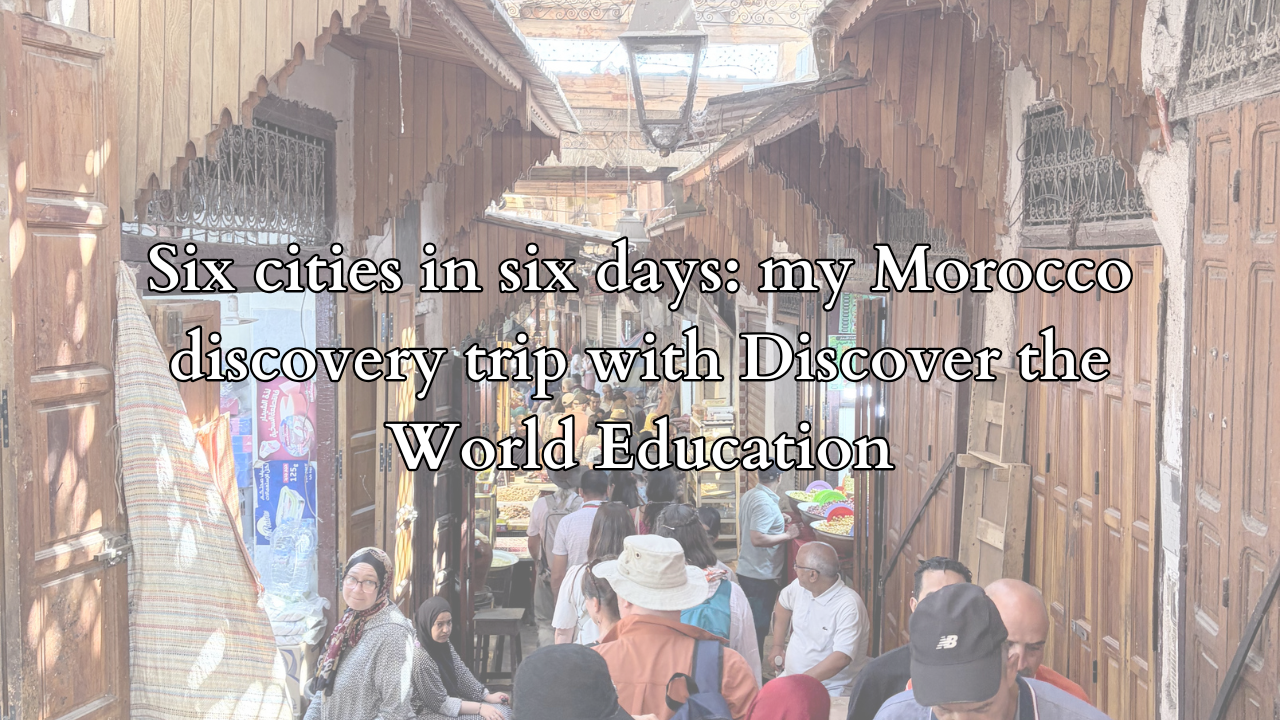
In May 2026, I had the chance to do something I still can't quite believe.
I spent a week travelling through northern Morocco with Discover the World Education, as part of a small group of teachers and language specialists invited to experience their school trip itineraries firsthand.
The idea behind the trip was straightforward. Before DTWE finalises an itinerary, they want it tested and shaped by people who actually teach the subject, people who know what works in a classroom and what students will genuinely get out of a place. So a handful of us were sent off to explore, ask questions, eat far too much delicious bread, and come back with honest feedback.
Six cities in six days sounds like a lot, and it was, but it gave me a real sense of just how much Morocco has to offer, and how easily a school trip itinerary could be built around it.
First impressions
Landing in Morocco felt genuinely different. The colours are different, the sounds are different, and even the pace of the streets feels different. There's a real sense from the first morning that you've gone somewhere properly new, while still being only a few hours' flight from the UK. For students who might already have done a more familiar language trip, that contrast alone is worth a lot.
The French itinerary: Rabat, Meknès and Fes
If you teach French, the imperial cities of Rabat, Meknès and Fes form the backbone of DTWE's French itinerary. I went in expecting a nice trip and came out thinking about how many lessons I could build around it.
Rabat was a real highlight for me. There's a striking modern art museum, some genuinely impressive contemporary architecture (keep an eye out for the new football stadiums going up across the city), and then there's Chellah. I'm not sure I've been anywhere quite like it. Roman ruins and a medieval necropolis sit side by side, with hundreds of storks nesting in the walls above you. It's the kind of place where you could talk about ancient history, Islamic architecture and the natural world all in the space of one visit, and all in French.
Fes medina is on another level entirely. It's a UNESCO World Heritage Site, and walking through it feels like stepping into a different century. The streets are a proper labyrinth, the architecture is extraordinary, and the tanneries are exactly as sensory as everyone says. The sprig of mint they hand you on arrival isn't just for show, so take it gratefully!
One of my favourite parts of the whole trip happened in the evening, when we took part in a tagine cooking class at a local riad. We made our own tagines from scratch, and the result was honestly some of the best food I ate all week. If you're planning this with students, my one tip would be to schedule it earlier in the afternoon rather than the evening. By the time ours was ready, everyone was starving, and the wait felt a lot longer than it actually was.
The Spanish itinerary: Chefchaouen, Tétouan and Tangier
For Spanish, DTWE's itinerary takes in Chefchaouen, Tétouan and Tangier, and each of these felt quite different from the cities further south.
Chefchaouen is somewhere I'd happily go back to just for the calligraphy lesson we took part in. It was delivered in French during our trip, though it's available in Spanish too, and it's exactly the kind of skills-based, hands-on activity that students remember long after a trip ends. There's something about sitting down and actually practising the script with calligraphy pens that makes it feel real in a way a worksheet never quite manages.
Tétouan was the city that surprised me most, and for Spanish classes in particular, I think it's a real find. The Andalucian influence is everywhere, in the architecture, the street layout, even the food, and for A Level students studying the expulsion of the Moors or Spain's colonial history, this is the kind of place that makes those topics click in a way no textbook can manage. Tétouan was once the capital of the Spanish protectorate in Morocco, and you can still feel that history woven through the city today.
Tangier rounds off the itinerary, and it's a brilliant contrast: vibrant, cosmopolitan and right on the coast. From certain points in the city you can actually see Gibraltar and the south of Spain across the water, which is a genuinely powerful moment to share with a class studying Spanish geography or the history of the Strait.
Why this matters for MFL students
What struck me most about the whole trip wasn't just how beautiful Morocco is, although it really is. It was how naturally everything connected back to what we teach.
These itineraries aren't generic tourist trips with a language label stuck on top. The activities are built around real-world language use, whether that's a calligraphy class, a market visit, or simply ordering food in French or Spanish. Students get to step outside the classroom and use the language they've been learning in a context that actually matters, in a way that's genuinely hard to recreate at home.
There's also the curriculum side. Between the history in Tétouan, the architecture and Islamic heritage in Fes and Rabat, and the cultural diversity woven through every city we visited, there's a huge amount that links directly to GCSE and A Level content, often in ways that bring topics to life far more vividly than a textbook page can. And beyond the specific curriculum links, there's something to be said for the simple value of learning outside the classroom altogether. Students who get to see, smell and taste a place tend to remember it, and the language attached to it, in a way that lessons alone rarely achieve.
Built with teachers, not just for them
One thing I really valued about this trip was the process behind it. DTWE's itineraries are developed by former language teachers, and our discovery trip was a chance for them to gather feedback from people currently working in MFL classrooms, or in my case, someone who's spent a long time in them and works with hundreds of languages teachers on a daily basis.
Along the way, we were asked what we thought would work for students, what might need adjusting for a school group, and what we, as teachers, would want to get out of each stop. That kind of practitioner-led approach felt different to me. It's reassuring to know that the trips on offer have been shaped by people who understand what makes a school trip worthwhile, not just what makes a good holiday.
Is Morocco worth considering for your students?
I think Morocco is a genuinely underrated option for school trips. It's accessible, it's culturally rich, and it sits just far enough outside the usual France or Spain comfort zone to feel like a proper adventure. If you're trying to get a trip signed off by your school, that sense of adventure can make all the difference.
It also offers something a bit different for students who might already have been on a more familiar language trip. There's a real sense of discovery to it, in the literal sense, and that's something students pick up on too.
A few practical things to think about
If you're thinking about Morocco for a future trip, a few things from my own experience might be worth bearing in mind.
- Build in some pre-trip vocabulary work around food, markets and directions. Students will use this constantly, and it makes the experience feel immersive from the start.
- If a cooking class is on the itinerary, try to schedule it earlier in the day if you can. Hungry teenagers and a slow-cooked tagine are not a great combination!
- The medinas involve a lot of walking on uneven ground, so comfortable shoes are essential, and it's worth flagging this to students and parents in advance.
- A bit of background on the history of northern Morocco, particularly its links to Spain, goes a long way. Students engage so much more with places like Tétouan when they already have some context to work from.
Final thoughts
I came back from this trip with a notebook full of ideas, a phone full of photos of storks, tagines and very blue streets, and a genuine enthusiasm for Morocco as a destination for language students.
If you've been considering a school trip and want something that feels a little different while still being firmly rooted in what your students are learning, DTWE's Morocco itineraries are well worth a look. The French itinerary is based around Fes, Meknès and Rabat, and the Spanish itinerary around Tangier, Chefchaouen and Tétouan.
You can explore both itineraries here: DTWE Morocco itineraries
As always, if you've got any questions, just get in touch!
Stay connected with news and updates!
Join my mailing list to receive a free retrieval practice ebook, exclusive offers, freebies and to be the first to know about new resources and sales!
