
One text, 5 skills, foundation and higher
Sep 03, 2026
Sometimes I think we try to overcomplicate “differentiation” or “adaptive teaching”, or whatever we’re calling it these days in our MFL lessons… but as long as you have a good quality text, some scaffolding and extension tasks up your sleeve, you’re good to go!
Read on to find out how I recommend adapting a single text in multiple ways when you have both foundation and higher students in your French, German and Spanish GCSE classes.
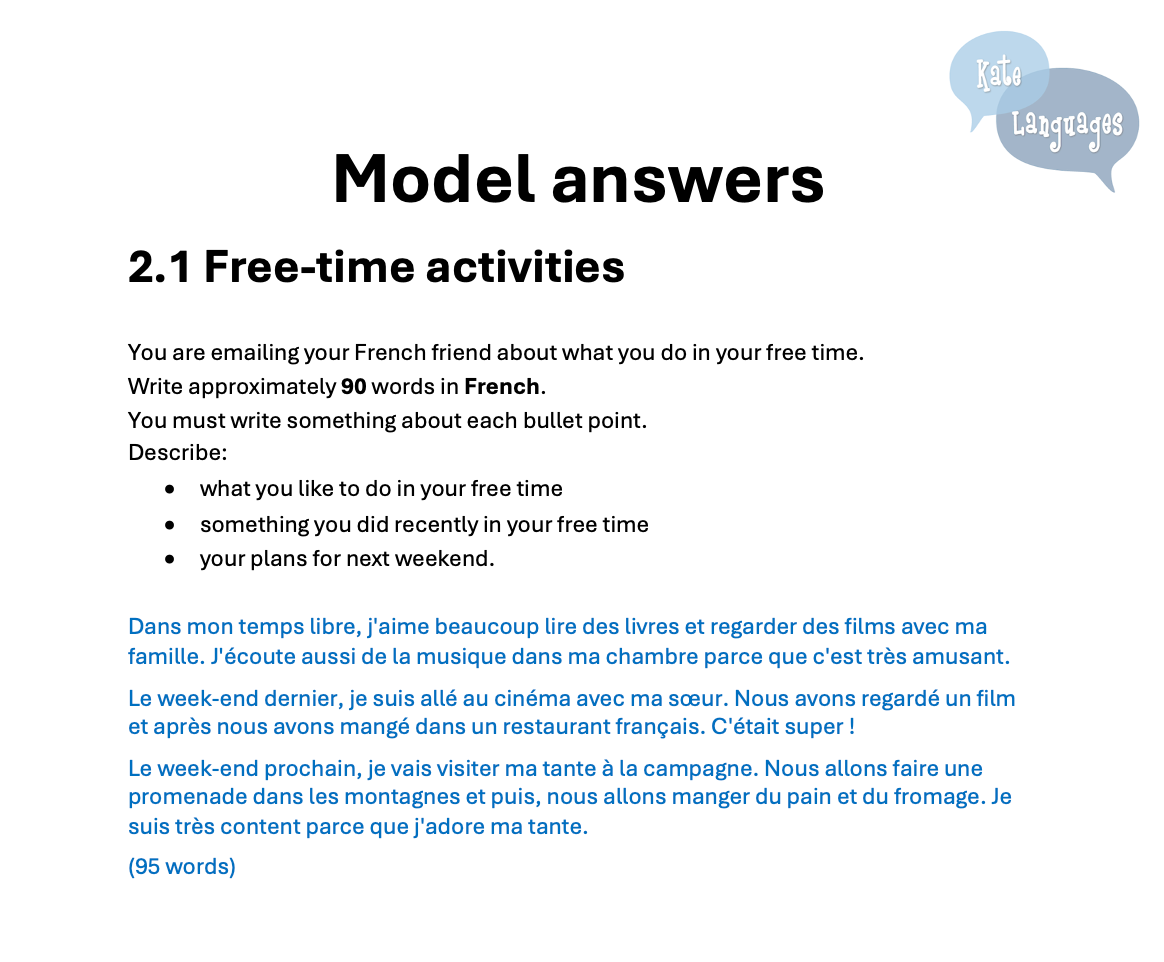
The lesson plan outlined below uses the French AQA GCSE 90-word model answer shown above, but can be replicated for any topic, any language, and even for KS3 or A Level!
1. Use the model answer as a listening task - read aloud or use AI.
Foundation: Finish the sentences. E.g. He watches films with his ...
Higher: Give A and B statements. (Students write A if only A is true, B if only B is true and A+B if both are true.). E.g. He likes...
A - listening to music in his bedroom.
B - watching films at the cinema.
2. Dictation
Foundation: Give students the transcript with gap fills.
Higher: Write out the full sentences.
NB This is much harder than the dictations in the GCSE exam, but great practice in lessons!
3. Reading aloud
Foundation: First paragraph only - present tense and close to the 35 words required in the exam.
Higher: One sentence from each paragraph, to have a variety of tenses, needs to be around 50 words.
4. Translation into English
Foundation: Translate one sentence from each paragraph. Further scaffolding - match the French and English sentences.
Higher: Translate the whole text into English.
5. 90-word writing task
This is an overlap question, so both foundation and higher students need practice with it!
Foundation: replicate the text to make it true for them - stick closely to the model answer and change some words.
Higher: improve the text with more connectives, words from the higher vocab list, a wider variety of tenses, etc.
If you’d like to dive deeper into my “exploiting one text” methodology, which is essentially what this lesson follows, you can listen to my podcast episode about it here, and see lots of examples in practice with my resources and online course “Structuring an Outstanding MFL Lesson”.
Stay connected with news and updates!
Join my mailing list to receive a free retrieval practice ebook, exclusive offers, freebies and to be the first to know about new resources and sales!
